Physical Address
304 North Cardinal St.
Dorchester Center, MA 02124
Physical Address
304 North Cardinal St.
Dorchester Center, MA 02124

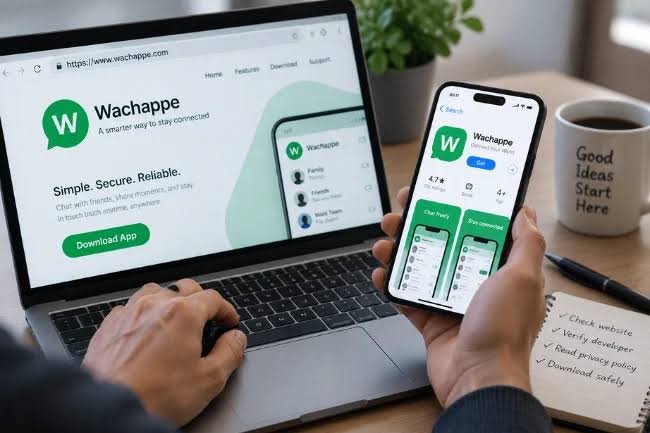
You type a strange word into Google and find only vague blog posts. That is how most people meet Wachappe. One page calls it a powerful chat application. Another page never says what it is. So what is the truth? This guide gives you clear facts in easy English. You will learn what the term may mean, why it looks like WhatsApp, and how to stay safe before you tap any download button.
What is Wachappe? Right now, no one can give a firm answer. The word looks like a brand for a messaging platform. Yet no verified company, developer, or launch notice stands behind it. Most pages that mention it repeat the same vague claims. So the safest Wachappe definition is simple. It is an unconfirmed online term that people link to chat tools and online communication.
The Wachappe meaning can also change with context. Some writers treat it as a Wachappe app. Others see a joke, a nickname, or a spelling slip. Each view has some logic, but none has proof. Think of this as Wachappe explained in one line: it is a name in search of a product. Keep that in mind as you read on.
People search for odd words for many reasons. Curiosity comes first. A friend drops a strange name in a chat, or a post mentions it, and people grab their phones to look it up. Wachappe fits that pattern well. It sounds familiar, it feels new, and it hints at a modern messaging platform. That mix pushes online search intent toward quick answers and fast clicks.
Content sites also feed the trend. Many of them publish short pieces on unknown terms because search volume is rising. Then more readers find those pages and search again. As a result, a loop forms. Interest grows even when facts stay thin. This is a clear example of how digital communication trends can run ahead of proof.
A real messaging app leaves a clear trail. You can find a named developer, a store page, a privacy policy, and honest user reviews. A web search for Wachappe shows blog-style pages but no official store page or company site. That gap matters. It does not prove the app never existed. It does mean you cannot treat it as a trusted chat application today.
Yes, and this is the most likely answer. WhatsApp is the best-known messaging service in the world, and people mistype names all the time. A WhatsApp misspelling like this one can turn into a search term fast. Wachapp is another close variant that follows the same pattern. Typo-related searches spread because users copy what they see online. In short, a common WhatsApp typo may explain the whole mystery.
Another idea treats the word as internet slang. Some people may use it as a casual greeting, much like a playful “what’s up” meaning. Others may use it as an informal greeting among friends. If so, it works as an online expression, not a product. Slang changes quickly, so no single definition fits every group. Evolving online language makes this kind of term hard to pin down.
The two names share the same rhythm. Say them out loud and you hear “wha” followed by “app.” WhatsApp itself plays on the phrase “what’s up.” So Wachappe feels like a cousin, a clone, or a new version. Messaging app confusion grows from this kind of sound match. Our brains take shortcuts, and a familiar sound feels like a trusted brand.
Is Wachappe connected to Meta? No public source shows any link. Meta, then called Facebook, bought WhatsApp in 2014, and no Meta announcement for a product with this name appears in search results. Similar names also fool people in other fields. Scammers know this and copy trusted brands on purpose. So a lookalike name should raise your guard, not lower it.
Read a few pages and you will see the problem. One calls it an all-in-one communication tool. Another says it is a secure messaging app. A third treats it as a typo. They cannot all be right. Many of these pages use the same stock phrases, such as seamless connectivity and modern communication. They rarely name a team, a version number, or a launch date.
This pattern is common for unverified topics. Writers fill space with generic claims because real data does not exist. They seldom show screenshots, store links, or developer details. When you spot that gap, treat the page as opinion. Look for primary sources instead. An app store listing or a company website tells you far more than a blog post that repeats the same lines.
Some pages list features for Wachappe. Remember that these claims are unverified. Still, they follow the usual checklist of a modern messaging platform, so they are worth a look. Use them as a guide for what to expect from any digital communication platform. Do not use them as proof about this one.
The most common claim is real-time messaging. Users would send text messages, record voice messages, and place voice calls or video calls over the internet. These calling features run on Wi-Fi or mobile data, so they avoid phone-line fees. Apps like WhatsApp and Signal already offer all of this. Fast, clear internet communication is now the baseline, not a special feature.
Pages also mention group chats, community engagement, and syncing across phone, tablet, and web-based messaging. Cross-platform messaging matters because people switch devices often. A good chat application keeps your history in step on each one. It also keeps your online conversations smooth, whether you use a phone at home or a laptop at work.
Multimedia sharing is the final claim. Users would share photos, share videos, share audio files, and send documents. File sharing also helps team communication and business collaboration. Check the size limits and privacy rules before you upload anything private. A tool with strong sharing features still fails you if it handles your data badly.
Think about how any chat app works. You install it, enter a phone number or email, and confirm your identity. Then the app builds a contact list and opens a channel for one-to-one messaging. Servers carry each message to the other person’s device. A user-friendly interface and intuitive design make the whole process feel instant. Good design also keeps user connectivity simple for new users.
A serious service adds more layers. It offers account security tools, such as two-step login. It gives you privacy settings, so you control who sees your photo and status. It may add smart messaging tools, such as translation or suggested replies. Some brands call this AI-powered communication or next-generation communication. Yet these labels mean little without a real product behind them.
At the time of writing, no verified developer, official site, or store listing for a Wachappe platform appears in web search results. Pages that claim to host the app are third-party blogs. App store availability is the first sign of legitimacy, and this term fails that test for now. Always check Google Play or the Apple App Store yourself before you trust any claim.
Is it free or paid? No one can say, because no official pricing exists. A promise of a free download should raise doubts. Real apps show pricing, in-app purchases, and terms inside the store page. Names can also mislead. For example, WChat is an unrelated Apple Watch app that links to WhatsApp Web, and WhatsApp and Meta do not back it. A similar name is not a connection.
Safety depends on who builds the app and how they handle data. For Wachappe, nobody can answer either question. You cannot check a verified development team, a policy page, or a security audit. So an unverified platform like this carries real app safety concerns. Treat it as unsafe until clear proof shows otherwise. This simple rule protects your account and your contacts.
Privacy needs proof too. End-to-end encryption means only the sender and the receiver can read a message. WhatsApp turned it on by default for all chats in 2016, and Signal built its name on it. Wachappe claims about encrypted conversations have no public backing. Without that backing, confidential messages could sit on a stranger’s server. That setup invites unauthorized access and weak data protection.
An APK is the file format Android uses to install apps. Official stores scan apps for malware before they list them. A random APK from a blog skips that check. Attackers often hide spyware or ad fraud code inside a fake chat tool. So suspicious downloads are the biggest risk linked to this term. One wrong tap can expose your photos, contacts, and bank apps.
If a page pushes a Wachappe APK, stop. Do not install it, even if the reviews look good, because fake reviews are easy to post. Use only secure links and downloads from official stores. If you already installed a file, remove it and run a security scan. Then change the passwords for any account you used on that device. Act fast, since delay gives bad apps more time.
The two names look alike, but the facts differ sharply. WhatsApp has a known owner, public policies, and more than 2 billion users. Wachappe has none of these. The table below puts them side by side so you can see the gap at a glance.
| Feature | Wachappe | |
|---|---|---|
| Owner | Not confirmed | Meta |
| Official website | None verified | Yes |
| App store listing | None verified | iOS and Android |
| Encryption | No public proof | Default for chats |
| Privacy policy | Not found | Published |
| Pricing | Unclear | Free for personal use |
| User base | Unknown | More than 2 billion |
The lesson is plain. WhatsApp is a proven messaging platform. Wachappe is a name without proof. If your goal is secure messaging, pick the app with a track record. Many people who search for a WhatsApp alternative want better privacy or lower data use. Those goals already have verified answers, as the next section shows.
Plenty of trusted apps cover every need. Each one has a public developer, a store page, and a privacy policy. Choose based on your privacy needs, your device, and the people you talk to. A good fit supports both personal communication and professional communication without extra stress.
Telegram works well for large group chats and public channels, and it syncs fast across devices. Regular chats use cloud storage, though, and only Secret Chats are fully encrypted. Choose it for community engagement and big groups. Do not pick it if private communication is your top goal.
Signal is a nonprofit project with open-source code. It uses end-to-end encryption for messages and calls by default. It also collects very little user data. Pick Signal for private communication and strong digital security. It suits journalists, families, and anyone who wants fewer data trails.
Messenger fits people who live on Facebook and Instagram, and Meta made encrypted chats the default for personal conversations in late 2023. Google Messages replaces plain SMS with RCS on Android and encrypts RCS chats. Both tools offer a clean interface and easy navigation. They also link naturally to the social interaction you already have on those platforms.
You can verify a messaging app in a few minutes. Treat these checks as due diligence online. They work for Wachappe and for any new chat tool. Each step takes little time, and together they block most scams. Build the habit once, and it protects you for years.
Look for a named company with a real address and a working site. A verified development team often has other apps and a public history. A hidden owner is a warning sign. Also check that the website matches the store page. If the names, logos, or claims differ, walk away.
Open the store listing and check the update history, ratings, and permissions. Then read the privacy policy. Good apps explain what data they collect and why. If a chat app asks for your contacts, camera, and location for no clear reason, skip it. Regular updates show that a real team still maintains the product.
Search for coverage from tech sites you trust, not only blogs that repeat the same text. Look for security audits and clear statements about encryption. Never share a verification code with anyone. That code opens your account, and scammers love it. If a stranger asks for it, end the chat at once.
Some groups face higher risk. Business owners who share client files need strong data protection. Parents should watch what their kids install, since young users tap download fast. Older adults and new smartphone users often trust names they only half know. Journalists and activists need private communication that holds up under pressure. All of these groups face bigger app safety concerns, and an unverified app is a poor bet for them.
If you searched for Wachappe, take these steps:
Wachappe is best seen as an unverified online term. It may be a WhatsApp misspelling, a piece of casual digital language, or a name that sites push for traffic. No proof shows a real, safe messaging platform behind it. Someone could still launch it as a real brand one day. If that happens, expect a named developer, press coverage, and a store listing.
Until then, stick to trusted apps and always verify a messaging app before you install it. Curiosity is fine, but risk is not. Names that look like big brands deserve extra care. The bigger lesson is simple: a familiar sound does not make an app real or safe. Good habits protect your digital trust far better than any trending name.
Wachappe is an unconfirmed online term. People link it to messaging apps, but no verified developer or official listing supports that claim. It may be a WhatsApp typo or a piece of internet slang. Until proof appears, treat it as a name, not a product.
No public source shows any link between the two. WhatsApp belongs to Meta and has an official site and store pages. Wachappe has none of these. The names sound alike, which is why many people confuse them.
No one can confirm that it is safe. You cannot check the developer, the privacy policy, or the security details. APK files from blogs add more risk. Stay with apps from official stores that show clear ownership.
At the time of writing, no verified website or store listing appears in web search results. Sites that claim to offer a download are third-party pages. Always check Google Play or the Apple App Store directly before you trust a claim.
WhatsApp, Signal, Telegram, Messenger, and Google Messages are all trusted choices. Signal is best for privacy. Telegram suits large groups. WhatsApp and Messenger suit people who want wide reach. Pick the one that matches your needs and your contacts.
Also Read: HRMtaila: How AI Is Changing Human Resources Management





[…] Labarty is a technology blog and digital knowledge hub. It publishes technology guides, tech news, and practical advice for everyday readers. The topics include AI tools, mobile apps, gadgets, software, and digital marketing. The site tries to explain each topic in simple words, so a reader does not need a technical background. That makes it a technology learning platform for beginners and casual users alike. […]