Physical Address
304 North Cardinal St.
Dorchester Center, MA 02124
Physical Address
304 North Cardinal St.
Dorchester Center, MA 02124

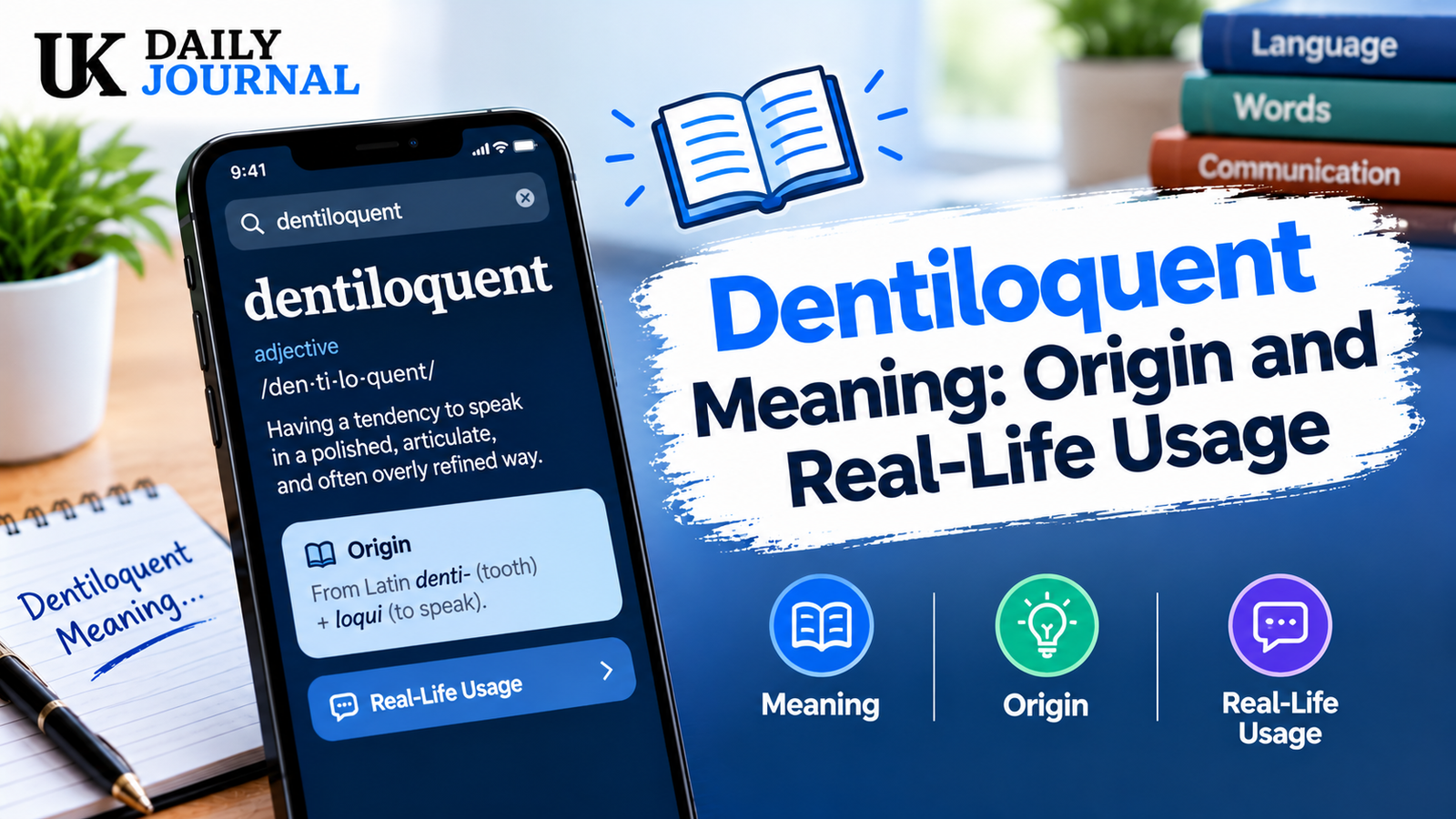
Someone says, “I’m fine,” but their jaw does not move. The words come out flat, tight, and low. You know right away that the person is not fine. English has a rare word for that exact moment: dentiloquent. Most readers never meet it in a dictionary, yet it paints a sharp picture. This guide explains the dentiloquent meaning, its Latin roots, and its pronunciation. It also shows you how to use the word without sounding odd.
Dentiloquent is an uncommon English adjective. It describes a person who speaks through their teeth. The jaw stays tight, and the lips barely move. Words come out low, flat, and clipped. The dentiloquent definition is simple: speaking with clenched teeth, usually while holding back a strong feeling. That feeling is often anger. However, it can also be tension, caution, or sarcasm. So a dentiloquent reply is more than a quiet reply. It carries a clear mood, and the listener hears it at once.
Here is the easy meaning. Dentiloquent means talking with your teeth held together. The speaker does not shout. The speaker does not whisper either. Instead, the voice squeezes out through a tight mouth. Most of the time, the tone shows anger or strain. Sometimes it shows plain self-control. The word is descriptive, not technical, so you will not find it on a medical chart. You will find it in a story, an essay, or a sharp piece of writing.
This quick table sums up the key facts about the word.
| Feature | Detail |
|---|---|
| Word | Dentiloquent |
| Part of speech | Adjective |
| Core meaning | Speaking through clenched teeth |
| Root words | Latin dens (tooth) + loqui (to speak) |
| Pronunciation | den-TIL-uh-kwunt |
| Rarity | Very rare; not in most major dictionaries |
| Related noun | Dentiloquy |
| Best use | Fiction, essays, and word play |
The word origin sits in Latin. English built dentiloquent from two Latin pieces. The first piece comes from dens, which means tooth. The second comes from loqui, which means to speak. Put them together, and you get “tooth speaking.” That is a fair match for the meaning. Many English words follow the same pattern, because they join a Latin root with a speaking ending. Eloquent, grandiloquent, and soliloquy all work this way. So the etymology feels familiar even if the word itself does not.
Now take the word apart. The prefix denti- links to dental terminology. You see the same root in dentist, dental, and denture. The ending -loquent links to speech. It also appears in eloquent and loquacious. Together, the parts form a Latin-derived word with a clear, literal sense. A related term is older. Dentiloquy is a rare noun for the habit of speaking through the teeth, and one word-of-the-day source dates it to 1913. Dentiloquent reads like its natural adjective partner.
The natural way to say it is den-TIL-uh-kwunt. The stress lands on the second syllable. The syllable breakdown is den, til, uh, kwunt, so the word has four syllables. A rough phonetic spelling is /denˈtɪləkwənt/. Because the word is so rare, no official pronunciation standard exists. Still, this version matches how similar words sound. Say it slowly at first. Then speed up until it feels smooth.
A simple trick helps with the sound. Think of grandiloquent, which people say as gran-DIL-uh-kwunt. Swap the first part for “den,” and you get den-TIL-uh-kwunt. Both words share the same ending and the same stress pattern. Eloquent works a little differently, since it puts the stress on the first syllable. So if you wonder how to pronounce dentiloquent, remember this line: grandiloquent with a tooth.
The honest answer has two parts. Dentiloquent is rare, and as far as I can tell, major dictionaries do not list it. Instead, it shows up on word-suggestion pages, vocabulary blogs, and word lists. So it works as a rare vocabulary term, not as a standard dictionary word. That does not make it meaningless, though. English lets people form new words from known roots. Readers understand them because the parts are clear. Some dictionary publishers also accept word suggestions from readers.
The related noun stands on firmer ground. Wiktionary-based references list dentiloquy as a rare word for the habit of speaking through the teeth. Dentiloquent reads like its adjective partner. Writers should know this status before they use it. In formal writing, add a short gloss. For example, write “his dentiloquent reply, spoken through clenched teeth.” That small phrase keeps every reader with you.
Dentiloquent speech sounds tight and held back. The sound turns muffled because the mouth barely opens. Vowels lose their shape, and consonants turn sharp or hissy. The voice often drops in volume. Yet the tone can feel loud in its own way, because the tension carries. Listeners pick up the strain at once. They hear a speaker who says, “I am controlling myself.” Body language backs it up. The jaw sets, the lips thin, and the neck stiffens.
Several clear signs mark this speech pattern:
Not every sign appears every time. Still, two or three together make the pattern easy to spot. Listen for the tone first. Then watch the face.
People speak this way for a few main reasons. The body reacts before the mind decides. The jaw tightens under stress, and the words then squeeze out through it. Each cause below shows a different side of the same habit.
Anger is the classic cause. A person feels irritated but wants to stay polite. So the feeling leaks out through the jaw, and the tone turns clipped and sharp. Learner dictionaries even use a picture of an angry person speaking quietly through clenched teeth. That example shows how firmly the image sits in everyday English. It is suppressed anger at work, with the feeling squeezed into a controlled voice. Some writers call this a gritted teeth tone.
Fear and stress tighten the jaw too. A nervous speaker may not feel angry at all. Instead, the person feels pressure from a hard talk, a tense meeting, or a sad moment. The mouth stays small, and the words come out thin and careful. A listener may hear a strained voice and see a forced smile. This kind of emotional speech shows effort, not rage. The speaker works to stay calm while the body gives away the strain.
Sometimes a person clenches on purpose. Think of a parent in a quiet library or a worker in an open office. The speaker wants to keep a private point private. So the mouth stays nearly closed, and the voice drops. This is emotional restraint in action. It can also show reluctance, such as when someone agrees to a request they dislike. The speech sounds held in, and the listener senses the hesitation.
Teeth shape speech more than most people think. Your tongue touches or nears the teeth to form sounds like th, t, d, s, and z. Your lower lip meets the upper teeth for f and v. When the teeth change, those sounds change too. Missing or shifted teeth can cause a lisp or a whistle. So teeth help the tongue find its place, but they do not make the sound on their own. This is why a closed, tight jaw alters how words come out.
Do not mix dentiloquent with dental consonants. Dental sounds use the tongue against the teeth, like the th in “think.” Dentiloquent speech is a manner of speaking, not a sound type. Phonetics has a rare term, bidental, for sounds made with both sets of teeth. Phoneticians say these sounds normally appear only in disordered speech. That topic is far from an angry person with a tight jaw. Keep the two ideas apart.
No. Dentiloquent describes a style, not a medical condition. A person can speak this way for a few seconds and then relax. A speech disorder, by contrast, stays steady and does not depend on mood. If you have jaw pain, teeth grinding, or constant trouble with speech, see a dentist or a speech therapist. The word itself carries no diagnosis.
Use dentiloquent as a descriptive adjective. Most examples place it before a noun or after a verb like “sound” or “stay.” Keep the sentence short and visual. The reader should see the jaw and hear the tone. Here are four example sentences:
At home, a parent may answer a loud child in a dentiloquent whisper. At work, a manager may thank a late employee in a dentiloquent voice. In public, a shopper may reply to a rude stranger with dentiloquent words while the line watches. All three scenes share one trait: the speaker holds the feeling in. The word fits best when the mood is visible but the volume stays low.
Fiction thrives on small, sharp details. Dentiloquent gives you one. It lets a writer show a mood without stating it. Instead of writing “he was angry,” you can say he spoke in a dentiloquent tone. The reader fills in the rest. This is creative writing vocabulary at its most useful: one word, one image, one feeling. Still, use it sparingly. A rare word works once or twice in a story, not on every page.
Dialogue tags carry emotion too. A line like “Fine,” he said, dentiloquent and stiff, tells the reader more than the word “fine” does. Pair it with body language. Mention the tight jaw, the white knuckles, or the thin smile. These nonverbal cues make the scene feel real. The reader sees the restraint before the character admits it.
Habits make characters feel alive. One character may clench the jaw every time a rival speaks. Another may go dentiloquent only around family. These patterns show personality, and they also hint at history. A reader senses that the character has learned to hide feelings. Add a quiet detail, such as a hand flat on the table or a slow breath through the nose. Then the speech pattern becomes part of the person, not just a style trick.
Many rare words end in -loquent, so readers mix them up. Each one points to a different kind of speech. The table below gives a quick word comparison. The short notes after it explain the differences.
| Word | Core meaning | Focus |
|---|---|---|
| Dentiloquent | Speaking through the teeth | Mouth and jaw position |
| Eloquent | Speaking clearly and with force | Skill and persuasion |
| Loquacious | Talking a lot | Amount of talk |
| Grandiloquent | Using lofty, showy language | Style and word choice |
| Ventriloquist | Speaking without visible lip movement | A voice trick |
| Mumbling | Speaking unclearly | Clarity |
Eloquent speech is clear, smooth, and moving. Dentiloquent speech is tight and held back. One opens the mouth, and the other nearly closes it. A speaker can be both at once, but that takes real control.
Loquacious means talkative. A loquacious person fills the room with words. A dentiloquent person uses few words, and each one comes out tight. Quantity marks the first word, while mouth position marks the second.
Grandiloquent speech uses big, showy language. It is about word choice. Dentiloquent speech is about delivery. Someone can use plain words in a dentiloquent way. Someone else can use fancy words with a wide-open mouth.
Ventriloquism comes from Latin words for belly and speak. A ventriloquist talks while keeping the lips still, so a puppet seems to speak. Dentiloquent speech also limits mouth movement, but it does so because of emotion, not a trick. The common forms are ventriloquist and ventriloquial.
Mumbling means speaking unclearly, often from low energy or shyness. Muttering and murmuring sit close to it. Dentiloquent speech can stay sharp and clear in its words, even if the mouth stays tight. It adds the clenched jaw to the picture.
The phrase is the everyday version, and people use it often. Dentiloquent packs the same idea into one word. Use the phrase for plain writing. Use the word when you want a touch of color. Both share the image of speaking through gritted teeth while holding a feeling back.
English has a small family of words built on loqui. Magniloquent means speaking in a grand, high style. Multiloquent means talkative. Pauciloquent means using few words. Somniloquy means talking in your sleep. Each word adds a prefix to a speaking root. If you collect interesting English words, this family is a fun place to start.
Seeing the pattern helps you guess new words. When you meet an unknown word with -loquent or -loquy, think of speech. Then check the first part. Denti- means tooth. Magni- means great. Multi- means many. Pauci- means few. This is simple root word analysis, and it works well for vocabulary improvement. Each Latin-derived word you learn makes the next one easier.
The word shines in creative and descriptive writing. A novelist, a blogger, or a poet can use it to paint a mood in one beat. It also suits word games, language learning, and vocabulary lists. In casual talk, it works as a playful term among friends who love words. In formal or technical writing, skip it or add a short explanation.
Use it in these cases:
Avoid it in emails, reports, or any text where plain clarity matters most.
Three things trip people up. First, the word looks like medical language. The dent- root makes some readers think of dentists and tooth problems. Second, it sounds like eloquent and ventriloquent, so readers guess the wrong meaning. Third, almost no dictionary entry exists to settle the question. As a result, people fill the gap with guesses.
Online pages add to the mess. Some link the word to burnout tracking or AI tools, but those claims lack a clear source. The plain reading is the safest one: speaking through the teeth. When in doubt, define the word in your own sentence. Then no reader has to guess.
Link the word to a picture. Imagine a dentist asking you to open wide, and you refuse. Your teeth stay together, and you speak anyway. That is dentiloquent. Another trick is to split the word into dent (tooth) and loquent (speaking). Say “tooth talk” to yourself. The meaning sticks fast.
Practice helps too. Write three example sentences about your own scenes. Use the word once in a text to a friend who loves language. Say the pronunciation out loud a few times. Within a day or two, the word feels natural. Active use beats passive reading every time.
Dentiloquent is a rare, vivid word for speaking through clenched teeth. It comes from Latin dens and loqui. It describes tight, restrained speech, often tied to anger, strain, or control. Major dictionaries do not seem to list it, but its older cousin, dentiloquy, gives it a real root to stand on.
Use the word with care. It shines in fiction, essays, and word play. Pair it with body language and a short gloss when needed. Do that, and your readers will see the jaw, hear the tone, and feel the tension. One small word can do a lot of work.
Dentiloquent means speaking through your teeth. The jaw stays tight, the mouth barely opens, and the words come out low and clipped. The tone often shows anger, strain, or self-control.
As far as I can tell, major dictionaries do not list dentiloquent. The related noun dentiloquy appears as a rare word in Wiktionary-based references. So dentiloquent works best as a rare vocabulary term.
Say den-TIL-uh-kwunt, with the stress on the second syllable. It has four syllables. It follows the same pattern as grandiloquent.
No. Dentiloquent comes from the Latin word for tooth and describes speech through the teeth. Ventriloquism comes from the Latin word for belly and describes talking without visible lip movement, as with a puppet.
Yes, but use it with care. It works well in fiction, blog posts, and word games. In formal or technical writing, add a short explanation or choose the phrase “speaking through clenched teeth.”





[…] real emotional turmoil. So if you ask what is antarvafna, think of it as a clear label for your inner struggle. The word helps you notice the struggle instead of ignoring […]