Physical Address
304 North Cardinal St.
Dorchester Center, MA 02124
Physical Address
304 North Cardinal St.
Dorchester Center, MA 02124

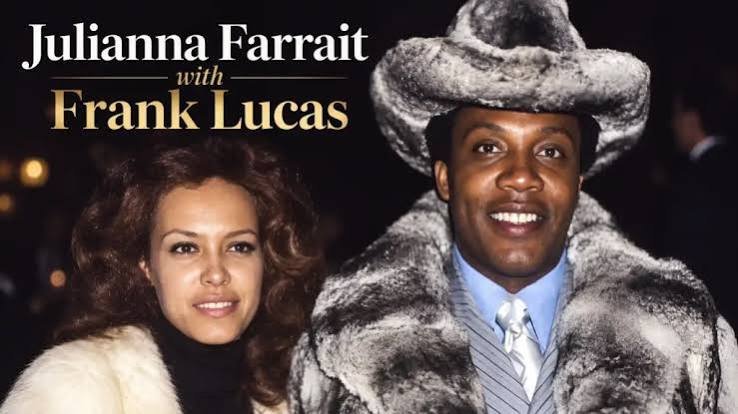
She married a man who once claimed to earn a million dollars a day. She wore fur coats to funerals. She went to federal prison more than once. And she is still, to this day, one of the least understood women in American crime history.
Julianna Farrait was not just the wife of Frank Lucas. She was his partner, his co-defendant, and in many ways, the quiet backbone of a criminal empire that shook Harlem in the 1960s and 1970s. Her husband became a household name after the 2007 film American Gangster. She stayed mostly out of the spotlight. But her own story, pieced together from court records and old newspaper archives, is just as dramatic as anything Hollywood could write.
This article walks through her early life, her marriage, her arrests, and where things stand for her today.
Julianna Farrait Rodriguez was born in Puerto Rico around 1941. She grew up far from the streets of Harlem, in a world that had nothing to do with narcotics or organized crime. That changed the day she met Frank Lucas.
Here is a quick snapshot of her life before we go further.
| Detail | Information |
|---|---|
| Full Name | Julianna Farrait Rodriguez |
| Also Known As | Julie Farrait, Julie Lucas |
| Born | Around 1941, Puerto Rico |
| Nationality | Puerto Rican |
| Spouse | Frank Lucas (married 1967) |
| Known For | Wife of Harlem drug trafficker Frank Lucas |
| Children | Francine Lucas-Sinclair and several others |
| Notable Arrests | 1975 New Jersey raid, 2010 Puerto Rico cocaine case |
| Husband’s Death | Frank Lucas died in 2019 |
She is often called a Puerto Rican beauty queen in older articles, and some reports describe her as a homecoming queen back home before she ever set foot in New York. Whatever her early title, none of it prepared her for the life she was about to enter.
Details about Julianna’s childhood are thin. Most biographies agree she grew up in or near San Juan, Puerto Rico, in a working family with no ties to organized crime. She was young, striking, and by several accounts, already used to public attention before she ever left the island.
A few points stand out from the limited record we have:
This lack of detail is common with figures who never sought fame themselves. Frank Lucas published an autobiography and worked as a paid consultant on his own biopic. Julianna Farrait did neither. She lived quietly, even during the years she was married to one of the most talked-about criminals in New York history.
The most widely repeated version of their meeting comes from Frank Lucas himself. According to his account, the two met on a flight between Puerto Rico and New York sometime in the 1960s. They started talking. The attraction was immediate on both sides, and within a short time, a relationship formed.
There is a second, less common version floating around in some biographies. It suggests the pair may have crossed paths at a nightclub during one of Frank’s visits to Puerto Rico, rather than on a plane. Neither story has strong independent documentation outside of what Frank Lucas told journalists and later, biographers. Because Frank was known for adding color to his own history, and because Julianna rarely gave interviews, the airplane story remains the version most commonly cited.
Whichever version is accurate, one fact is not in dispute: Julianna Farrait and Frank Lucas married in 1967, and from that point forward, her life was tied to his.
To understand Julianna’s story, it helps to understand the man she married. Frank Lucas was a Harlem drug trafficker who built one of the most profitable heroin operations in American history during the late 1960s and into the 1970s.
His story includes a few key elements that later became famous through news reports and the 2007 film starring Denzel Washington and Russell Crowe:
Frank Lucas was not just a drug trafficker. He was, by most accounts, an innovator in how narcotics moved through American cities during the 1970s Harlem drug scene. When Julianna married him, she was not simply marrying a criminal. She was marrying the center of a growing drug empire, one that would eventually inspire a major crime film.
The couple married in San Juan, Puerto Rico, in a small ceremony performed by a judge of the peace. It was simple, not extravagant, despite the wealth that would later surround them. Reports describe Julianna wearing a modest dress rather than anything flashy, a detail that stands in contrast to the luxury lifestyle crime that would follow.
Unlike many so-called crime couples whose relationships fell apart under legal pressure, Julianna and Frank Lucas stayed connected across five decades. They went through prison sentences, a federal drug charges case, family separation, and years of reduced circumstances. Through all of it, they kept returning to each other. Some writers have described them as a real-life Black Bonnie and Clyde, a Harlem kingpin and his wife who weathered raids, arrests, and years apart, only to reconcile again and again.
Julianna Farrait and Frank Lucas raised a large family together. Some of the children were Julianna’s own, while others were Frank’s from earlier relationships, folded into the household after the marriage.
The most publicly known of the children is Francine Lucas-Sinclair, who has spoken about her parents in interviews and documentaries over the years. She has often served as the family’s public voice, since both of her parents largely avoided cameras.
| Child | Relation |
|---|---|
| Francine Lucas-Sinclair | Daughter, most publicly known |
| Frank Lucas Jr. | Son |
| Ray Lucas | Son |
| Betty Lucas | Daughter |
| Candace Lucas | Daughter |
| Ruby Lucas | Daughter |
Family life inside the household was unusual, to put it plainly. The children grew up around wealth built on heroin trafficking and cocaine sales, but also around federal investigations, sudden raids, and long stretches where one or both parents were behind bars. Francine Lucas-Sinclair has described a childhood shaped as much by fear as by comfort, a common thread in narcotics conspiracy cases where children are the ones who absorb the fallout without ever committing a crime themselves.
At the height of Frank Lucas’s power, the family lived a genuinely luxurious lifestyle. There were expensive cars, including a Mercedes. There were fully furnished homes decorated well beyond what a typical New York or New Jersey household could afford. Julianna wore extravagant outfits that matched her husband’s public image as a man who had made it, whatever the source of that wealth.
The most famous detail from this era is the chinchilla coat story. Frank Lucas wore a full-length chinchilla coat and matching hat to a high-profile boxing match at Madison Square Garden, a move that drew far more attention than he wanted. Investigators later said this single public appearance helped put federal agents on his trail, since a low-level drug distributor was never supposed to look that wealthy in public. Julianna herself was known to wear a maxi-length chinchilla coat of her own, a detail that later became a small but memorable piece of the family’s legend.
That single fashion choice is often cited as one of the turning points that led to the federal investigation closing in on the couple.
In 1975, federal and local narcotics agents raided the Lucas family’s New Jersey home. This was part of a larger law enforcement effort to dismantle Frank Lucas’s drug empire, which by that point had drawn attention at the highest levels of narcotics enforcement.
During the raid, agents found large amounts of hidden cash throughout the home. Julianna was arrested for concealing money tied to the family’s drug proceeds. She was convicted on charges connected to the raid and reportedly served close to four and a half years in federal prison, a heavy sentence for a woman who had never previously faced criminal charges.
This raid marked the end of the family’s period of open luxury. From that point forward, life for Julianna Farrait and her children looked completely different.
After the 1975 case, both Frank and Julianna became connected to a much more cautious, lower-profile existence. Frank Lucas cooperated with federal investigators as part of a larger case against corrupt police officers and other narcotics figures, and this cooperation placed the family under witness protection for a period of time.
For Julianna, this meant raising children under new identities, in new locations, away from the extended family and community she had known. After her own release from prison, she took her daughter Francine to Puerto Rico to stay with her parents while Frank remained incarcerated. This period of family separation stretched on for years, and it reshaped the relationship between Julianna and her children in ways that outlasted the criminal case itself.
Just when it seemed the Lucas family’s criminal chapter had closed, Julianna Farrait found herself back in the headlines. In May 2010, at the age of 70, she was arrested in a hotel in Puerto Rico after allegedly attempting to sell 2 kg of cocaine to undercover agents.
She appeared in federal court in San Juan and was charged with conspiracy to violate narcotics law. According to news coverage at the time, she said almost nothing during the hearing beyond a request to have proceedings conducted in Spanish. The case drew renewed national attention, largely because of her connection to Frank Lucas and the ongoing fame of American Gangster, which had been released just three years earlier.
Following the case, Julianna received a five-year federal prison sentence for her role in the cocaine trafficking arrest. This 2010 drug indictment closed out one of the strangest chapters in her life: a woman in her seventies, decades removed from her husband’s original drug empire, back in federal custody for narcotics.
Julianna’s second prison sentence placed real strain on her marriage. For a period, she and Frank Lucas lived apart, both dealing with the consequences of their respective criminal histories and advancing age. Some reports describe this stretch as a genuine separation rather than a temporary distance caused by incarceration alone.
By most accounts, the couple reconciled by the mid-2000s to late-2000s and remained together through Frank’s declining health. Julianna reportedly asked courts for leniency during her later legal troubles specifically so she could care for her aging husband, a detail that speaks to a relationship built on more than shared criminal history. Whatever their years apart looked like, they ended up back together, a pattern that had repeated itself more than once across their marriage.
When American Gangster hit theaters in 2007, audiences met a character named Eva, played to reflect Frank Lucas’s wife. The film presents her as devoted, glamorous, and quietly present through her husband’s rise, without going deep into her own criminal history or arrests.
The real Julianna Farrait was more complicated than the movie version. A few key differences stand out:
The gap between Eva Lucas and Julianna Farrait is a useful reminder that crime films based on true stories tend to simplify the women involved, turning them into symbols of loyalty rather than full people with their own legal history.
Frank Lucas died in 2019, closing the book on one of the most talked-about criminal careers in Harlem’s history. By this point, the two had reportedly reconciled and remained connected, despite the years of separation, prison time, and family upheaval that had defined much of their marriage.
Following his death, public information about Julianna Farrait becomes noticeably thin. Unlike Frank, who gave interviews and cooperated with a biopic during his final years, Julianna returned to a quieter existence. Francine Lucas-Sinclair has occasionally spoken about her family’s history in interviews, but Julianna herself has largely stayed away from cameras and public statements.
This is one of the most searched questions about her, and the honest answer is that there is no widely confirmed, well-documented report of her death. Based on her reported birth year of around 1941, she would be in her mid-eighties as of 2026. Beyond that, reliable, independently verified information about her current status is limited.
Several biography sites list her simply as a private figure whose public record ends with her legal history and her connection to Frank Lucas. Given how private she has remained even during the height of her husband’s fame, it would not be surprising if she continues to avoid public attention rather than having passed away without notice. Readers should treat any specific claim about her death with caution unless it comes from a verified news source or an official obituary.
A few smaller details round out her story:
Julianna Farrait’s life does not fit neatly into the role Hollywood gave her. She was not simply the loyal wife standing behind a famous criminal. She built her own criminal record, served her own prison time, and made her own choices across five decades tied to one of America’s most notorious drug empires. Her story is one of survival, loyalty, and consequence, playing out far from the cameras that followed her husband.
1. Who is Julianna Farrait? Julianna Farrait is the wife of Frank Lucas, the Harlem drug trafficker whose life inspired the 2007 film American Gangster. She was born in Puerto Rico and married Frank Lucas in 1967.
2. How did Julianna Farrait meet Frank Lucas? The most common account says they met on a flight between Puerto Rico and New York in the 1960s. Some biographies mention a nightclub meeting instead, though this version is less documented.
3. Was Julianna Farrait arrested? Yes. She was arrested during a 1975 raid on the family’s New Jersey home for concealing drug money, and again in 2010 in Puerto Rico for attempting to sell cocaine.
4. How many children did Julianna Farrait have? Reports list six children connected to the family, including Francine Lucas-Sinclair, Frank Lucas Jr., Ray Lucas, Betty Lucas, Candace Lucas, and Ruby Lucas.
5. Is Julianna Farrait still alive? There is no widely confirmed report of her death as of 2026. She has stayed out of the public eye for years, so her current status is not well documented.